

The choice between freehold vs leasehold Abu Dhabi decides what you actually walk away with, and most buyers only discover the difference at the registration stage. One gives you the land and the building for good. The other gives you the right to use a property for a set number of years before it returns to whoever owns the land underneath it. Same apartment, same view, same price bracket, very different asset.
That distinction matters more in Abu Dhabi than in most markets, because the rules here changed relatively recently and a lot of published advice has not caught up. Here is what each title gives you, where foreigners can buy which, and how to check before you sign anything.
What freehold means in Abu Dhabi
Freehold is the strongest form of ownership available. You own the property and hold a permanent interest in the land it stands on, with no expiry date attached. The title deed goes in your name, and you can sell it, mortgage it, lease it out or leave it to your heirs without asking anyone for permission.
Foreign ownership sits under Abu Dhabi Law No. 19 of 2005, which was amended in April 2019 to open freehold title to non-UAE nationals inside designated investment zones. Before that amendment, expatriate buyers could hold freehold title to apartments and villas as units, but their interest in land was capped at long-term rights of 99 years or less. The 2019 reform extended full ownership rights, including land, to foreign buyers within those zones.
Practically, this is why almost every project launched by Aldar, Modon, Miral and the other major developers since 2019 is sold as freehold. If you are buying new, freehold is usually what is on the table.
What leasehold really means here
“Leasehold” is the word buyers use, but Abu Dhabi law recognises a few distinct rights, and the label on a brochure is not always precise. Three are worth knowing.
- Usufruct. The right to use and benefit from a property owned by someone else, for a fixed term of up to 99 years. This is what most people mean when they say leasehold. You can sell or transfer it during the term, and it is common in older community developments.
- Musataha. The right to build on land belonging to someone else, for up to 50 years, renewable by mutual agreement for a further term. It is mostly used for commercial and development plots rather than homes.
- Long lease. A lease of 25 years or more, treated as a registrable real property right rather than an ordinary tenancy.
All of these must be registered on the real estate register, whatever the term length. That registration requirement is a protection, not a formality: an unregistered interest is far harder to defend, finance or sell. Note as well that a usufruct or musataha holder with a term of more than ten years can deal with that right, including mortgaging it, without the landowner’s consent, which is why these are genuine property interests rather than glorified tenancies.
The 7 differences that actually affect your money
Strip away the terminology and the decision comes down to seven practical differences.
Freehold vs Leasehold / Usufruct
| Factor | Freehold | Leasehold / usufruct |
|---|---|---|
| What you own | The unit and a permanent interest in the land, with no expiry date | The right to use the property for a fixed term, with the land owned by someone else |
| Maximum term | Perpetual | Up to 99 years (usufruct); musataha development rights up to 50 years, renewable |
| Title document | Freehold title deed in your name | Registered usufruct, musataha or long-lease interest |
| Resale | Sell at any time to any eligible buyer | You sell the remaining term, which shortens each year |
| Inheritance | Passes to heirs permanently | Passes to heirs for the remainder of the term only |
| Mortgage | Widely financed by UAE banks | Financeable, but lenders assess the remaining term |
| Golden Visa | Qualifies at AED 2 million valuation | Confirm eligibility with the ICP before relying on it |
1. The clock
This is the difference everything else follows from. A freehold title has no clock. A 99-year usufruct signed in 2026 has 99 years on it today and 79 years on it in 2046. The asset is quietly consuming itself, even while the market rises.
2. Resale value over time
A freehold unit is resold on its merits. A leasehold interest is resold on its merits plus the remaining term, and a short remaining term narrows your buyer pool. Early in a 99-year term this barely registers. It becomes a real pricing factor as the term runs down.
3. Mortgage access
UAE banks lend readily against freehold title. Leasehold interests can be financed, but lenders look closely at the remaining term against the loan tenor. If you plan to finance, raise this with your bank early rather than after you have paid a reservation deposit.
4. Inheritance
Freehold passes to your heirs permanently. A leasehold interest passes to them for whatever is left of the term. Separately, and this catches a lot of expatriate owners out, UAE inheritance defaults to Sharia principles unless you register a will. Non-Muslim owners in Abu Dhabi can register one with the Abu Dhabi Judicial Department, and it is worth doing regardless of which title you hold.
5. Golden Visa eligibility
The 10-year property Golden Visa is assessed on a property valuation of AED 2 million or more. Freehold ownership in an investment zone is the well-trodden route. If you are relying on a leasehold or usufruct interest to qualify, confirm eligibility directly with the ICP before you commit, because this is not the standard pathway and criteria change.
6. Control
Freehold means no superior landlord with a say in what you do. A usufruct comes with an obligation to keep the property substantially as you found it, and the terms of the grant bind you. Read them.
7. Where you are allowed to buy
This one is not a preference. It is a rule, and it decides the other six for you.
Where foreigners can buy freehold in Abu Dhabi
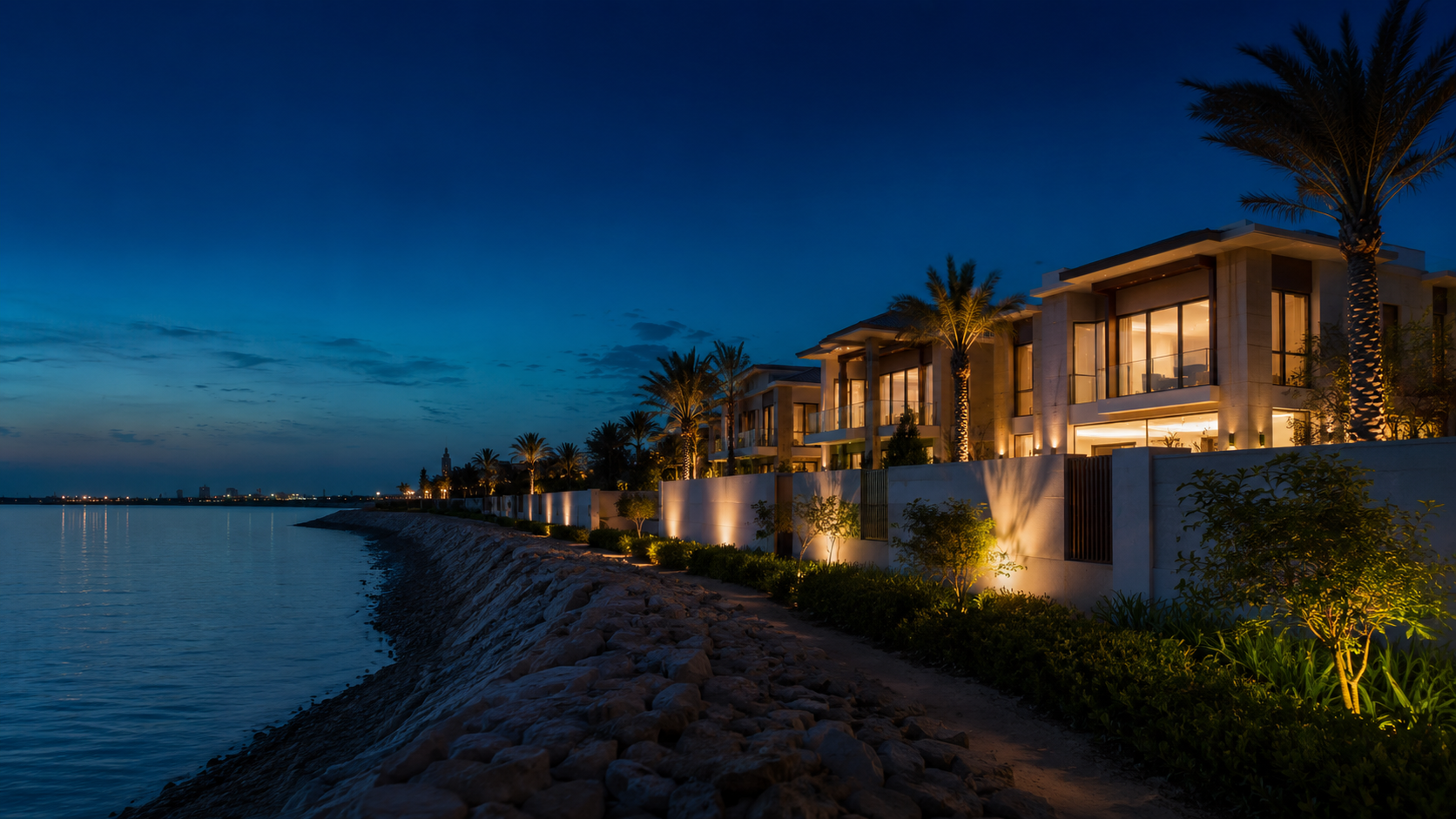
Foreign freehold ownership is confined to designated investment zones. Outside those zones, land ownership remains reserved for UAE and GCC nationals, and a foreign buyer’s options narrow to usufruct, musataha or a long lease. There is no way to negotiate around this, so zone status is the first thing to establish, before price, before payment plan, before anything.
The established investment zones include:
- Al Reem Island
- Yas Island
- Saadiyat Island
- Al Maryah Island
- Al Raha Beach
- Al Reef
- Masdar City
- Al Shamkha
- Nurai Island
- Al Falah City
The list has expanded over time and newer zones have been added since, so treat any published list, including this one, as a starting point rather than the final word. Confirm the specific plot or building with the authority before you sign.
The Al Reem Island exception most guides get wrong
If you are buying on Al Reem Island, the ownership rules are unchanged, but the registration process is not. Al Reem came under the jurisdiction of the Abu Dhabi Global Market (ADGM) through UAE Cabinet Resolution No. 41 of 2023. Since 1 January 2025, under ADGM’s Real Property Regulations 2024, property transfers, mortgage registrations, lease registrations and off-plan sales on Al Reem are processed by the ADGM Registration Authority through its AccessRP platform, rather than through ADREC’s DARI system used across the rest of the emirate.
To be clear about what this does and does not change. Al Reem remains a designated investment zone, and non-UAE nationals can still buy freehold there. What changes is the platform, the registering authority, and the fact that ADGM’s framework is built on English common law. Buyers and mortgage banks who assume the DARI workflow applies tend to hit friction at the transfer stage.
One further wrinkle worth flagging: usufruct and musataha are not recognised interests under the ADGM regulations, so no new ones are created within that jurisdiction. Rights that existed before the regulations came into force are handled under transitional provisions. If you hold an older interest on Al Reem, that is a conversation to have with a professional rather than a detail to assume your way through.
How to check what you are actually buying
Settling the freehold vs leasehold Abu Dhabi question for your own purchase takes four steps, in this order, before any money moves.
- Confirm the zone. Establish that the specific building or plot sits inside a designated investment zone open to your nationality. Not the community’s reputation. The specific address.
- Ask what title you will receive. Put it to the developer or seller directly: freehold, usufruct, musataha or long lease? Get the answer in writing, and if it is anything other than freehold, ask for the term and the start date.
- Check the registering authority. ADREC and DARI for most of Abu Dhabi. ADGM and AccessRP for Al Reem and Al Maryah. This determines your process, your paperwork and your timeline.
- Verify your broker. Every agent in Abu Dhabi must hold a valid Broker License Number. Verify it on ADREC’s document-verification tool before you engage.
A brochure that says “ownership” without saying which kind is not an answer. Neither is a verbal assurance. The title document is the only thing that settles it.
Freehold vs leasehold Abu Dhabi: which should you choose?
For most buyers the honest answer is that the choice makes itself. If you are buying a new-build apartment or villa in one of the investment zones, you are almost certainly buying freehold, and that is the right outcome: permanent title, cleanest resale, easiest financing, clearest Golden Visa route.
Leasehold becomes relevant when you want a location outside the investment zones, when you are looking at older community stock, or when you are structuring a commercial or development project where a musataha genuinely fits the plan. In those cases it is a legitimate instrument, not a consolation prize. It just needs to be priced and financed as what it is: a wasting asset with a defined end date.
The mistake is not choosing leasehold. The mistake is thinking you bought freehold and finding out otherwise at registration.
Talk to someone who checks before you commit
Sky Land has advised buyers in Abu Dhabi since 2014, and our founder brings more than 20 years of UAE real estate experience. We confirm zone eligibility and title type before a client commits, not after, and we work across ADREC and ADGM processes depending on where you are buying. Our consultants hold international credentials including CIPS, CRB, SRS and ABR.
Speak to an Abu Dhabi ownership specialist, or browse our current Abu Dhabi projects to see what is available in the investment zones.
Sky Land Middle East Properties is an ADREC- and RERA-licensed brokerage. This article is general information, not legal advice. Ownership rules and designated zones change, so confirm current requirements with ADREC or the ADGM Registration Authority before transacting.